Ritchie vs. Drinking Post: Choosing a Horse Waterer
Comparing Ritchie vs. Drinking Post automatic horse waterers: costs, installation, winter performance, and which system fits different properties and routines.
Ritchie vs. Drinking Post: A Real-World Comparison
We recently got a call from a customer — let’s call her Linda — who was trying to set up water for two horses at her son’s old farmhouse. Her son was about to be deployed, she had three young grandkids to help with, and as she put it, “I’m retired — I do not want to haul water all winter.”
Linda had heard about us from neighbors and came with a great question: “Do you recommend a Ritchie automatic waterer or that pole thing — the Drinking Post?” We install a lot of both, and we even use a Drinking Post at our own place, so her question turned into a really helpful on-site conversation.
In this post, I’ll walk you through the same comparison we gave Linda: how each system works, installation needs, costs, winter performance, and which one tends to fit different types of properties and owners.
How Ritchie and Drinking Post Waterers Work
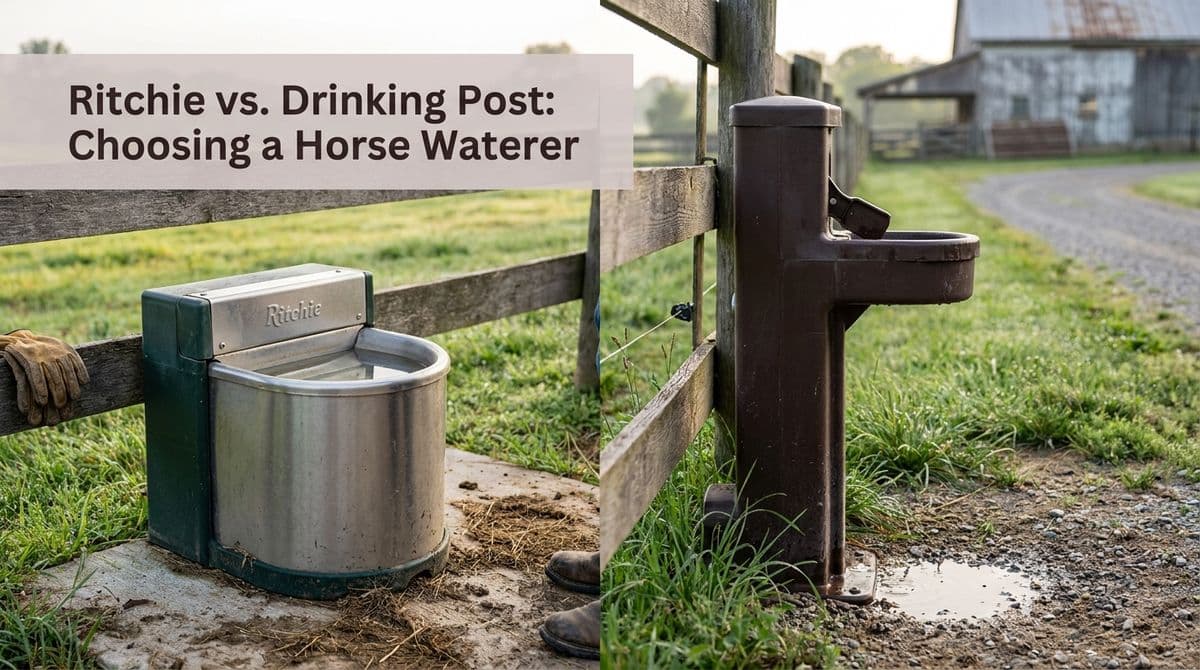
Ritchie automatic waterers are insulated water bowls mounted on a concrete pad. They use a low-watt heater and good insulation to keep a small amount of water open all winter. Horses drink from a standing reservoir that refills automatically as they drink.
Drinking Post waterers are vertical frost-free posts. There’s no standing bowl of water. When the horse presses the paddle, the valve opens, fresh water flows up, and when the paddle is released the remaining water drains back below the frost line.
So the basic trade-off is:
- Ritchie: small heated basin, always visible water.
- Drinking Post: no open basin, water only when activated, drains out after use.
Installation Requirements: Power, Concrete, and Trenching
When Linda called, she wasn’t even sure where the closest well or hydrant was on that old farmhouse property. That’s actually common with older places. Here’s what we typically look at.
Ritchie Installation
- Power: Needs electricity for the built-in heater. That usually means trenching a power line out to the pad.
- Concrete pad: Requires a properly sized, level slab for the unit to bolt onto.
- Water line: Needs a buried water line from the well or main, below frost depth.
This makes a Ritchie install a little more involved up front, but it’s a very solid, long-term setup — especially if we’re already trenching and you plan to keep horses there for years.
Drinking Post Installation
- No power needed: It’s a frost-free design, so no electric line or heater.
- No concrete pad: The post sets in an augered hole backfilled around the casing.
- Water line: Still needs a trenched water line below frost depth.
Because there’s no pad or power run, a Drinking Post is usually cheaper and quicker to put in. That’s why I told Linda they’re generally less expensive on the installation side.
Upfront Cost vs. Long-Term Maintenance
Both options have two cost buckets: what you pay to get it in the ground, and what you deal with over the next 10–20 years.
Ritchie Costs and Maintenance
- Higher upfront: Concrete, electrical, and the unit itself make the initial project cost higher.
- Low daily hassle: You simply walk by, look in the bowl, and know if the horses have water.
- Routine care: Periodic cleaning of the bowl, checking the heater, and inspecting valves and floats.
For folks like Linda, who may have family or farm sitters doing chores, that visible bowl is a big plus. It’s easy for anyone to confirm, “Yup, there’s water.”
Drinking Post Costs and Maintenance
- Lower upfront: No pad or power keeps installation costs down.
- More hands-on if something goes wrong: If it ices at the top or hangs up, you may need to pour warm water, work the mechanism, or call us to thaw and adjust it.
- Routine care: Occasionally cleaning the paddle area, making sure the drain zone isn’t packed with ice, mud, or bedding.
At our own place, we like the Drinking Post, but we’re also here every day and comfortable tinkering with it if needed. That’s an important difference.
Winter Performance and Freeze-Up Risk
Winter is where the choice really matters. Linda’s main concern was not hand-hauling buckets when it’s below zero.
Ritchie in Winter
- Heated basin: The built-in heater and insulation keep a small amount of water open even in very cold weather.
- Easy visual check: One glance tells you whether anything is frozen or not.
- Good for caretakers: Ideal if you travel or have someone else doing chores — less troubleshooting if temps dive.
Drinking Post in Winter
- Frost-free design: Water drains below frost line after each use, so there’s no standing water to freeze underground.
- Top-end issues: In extreme cold or if the top end gets packed with snow, ice, or mud, the paddle or weep area can freeze up.
- Fixing freeze-ups: Often solved with warm water, clearing ice, and cycling the valve — but it requires a bit more know-how.
That’s why, on the phone with Linda, I said: if you’re gone a lot in winter and someone else is doing chores, I’d lean toward a Ritchie. It’s simply more forgiving when the weather gets ugly.
Which Option Fits Your Property Best?
Your setup matters as much as the brand. When we come out for an estimate, here are the questions we walk through.
Owners Who Travel or Rely on Help
- Best fit: Ritchie
- Why: Easy to see water, simpler for non-horse experts to monitor, fewer “mystery” issues in deep winter.
Older Properties Without Power in the Paddock
- If adding power is hard or expensive: Drinking Post can be the more practical choice.
- If you’re already trenching power for other reasons: A Ritchie becomes more attractive long-term.
Single vs. Multiple Paddocks
In Linda’s case, all the horses shared one area, and they weren’t aggressive over water. A single Ritchie unit would easily serve her two (soon three) horses.
- Single shared paddock: One Ritchie or one Drinking Post is often plenty.
- Multiple or rotating paddocks: Sometimes it makes sense to install one central Ritchie between paddocks, or multiple Drinking Posts placed where you can reasonably trench water.
How We Help You Decide
With Linda, the deciding factors were clear: winter reliability, grandkids and caregivers doing chores, and her son leaving on deployment. We recommended a Ritchie, sized for a single shared paddock, tied into the nearest water source with a proper pad and power.
If you’re weighing Ritchie vs. Drinking Post for your own horses, we’re happy to walk your property, find your best water source, and talk through your routine — who’s doing chores, how often you travel, and how your paddocks are laid out. From there, we can give you a straightforward quote and a recommendation that fits both your budget and your peace of mind in January.